Campaign Scheduler for MailWizz EMA: A Deep Dive into Advanced Email Automation - Download Free
Campaign Scheduler for MailWizz EMA: A Deep Dive into Advanced Email Automation
MailWizz EMA stands as a formidable self-hosted email marketing platform, offering unparalleled control and cost efficiency for businesses of all sizes. Its robust feature set covers list management, campaign creation, and sending infrastructure, making it a go-to solution for those who prefer to keep their data and operations in-house. However, even the most powerful tools often reveal areas where specialized extensions can elevate their capabilities from excellent to exceptional. One such critical enhancement comes in the form of Campaign Scheduler for MailWizz EMA, an extension designed to fill a significant gap in MailWizz’s native scheduling functionalities. This review delves into its practical utility, architectural integration, and provides a comprehensive installation guide, all from the perspective of a seasoned web developer and technical journalist.
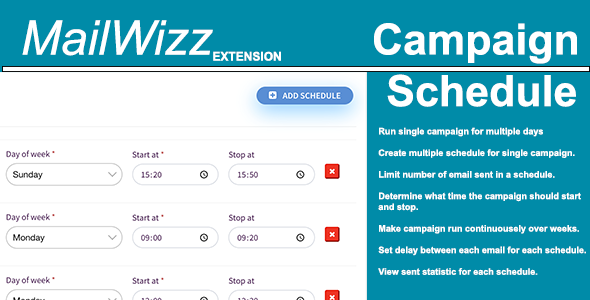
The Fundamental Scheduling Deficit in MailWizz EMA
Out of the box, MailWizz provides a solid foundation for sending email campaigns. You can create a campaign, define its content, select your audience, and then either send it immediately or schedule it for a specific date and time in the future. For many basic use cases, this is perfectly adequate. A one-off promotional email, a timely announcement, or a standard newsletter can all be handled with MailWizz's default scheduling mechanism. The limitation, however, becomes glaringly apparent when your marketing strategy demands more nuanced, recurring, or dynamically timed sends.
Consider the realities of modern email marketing: weekly digests, monthly reports, annual holiday greetings, birthday emails, or even multi-part drip campaigns that need precise, consistent timing without manual intervention. MailWizz's native scheduler falls short here. It's a "set it and forget it once" system, not a "set it and forget it forever" solution. This means that for any recurring campaign, a marketer would traditionally need to clone the campaign, adjust the date, and reschedule it manually each time. This repetitive task is not only a drain on resources but also a significant point of failure for consistency and accuracy.
This is precisely where the Campaign Scheduler extension steps in. It transforms MailWizz from a powerful but somewhat rigid sender into a flexible, automated marketing engine. It addresses the need for recurring campaigns, advanced future scheduling, and arguably, better timezone management, allowing for sophisticated campaign strategies that would otherwise require external automation or laborious manual effort.
Core Features: Enhancing MailWizz's Campaign Workflow
The Campaign Scheduler for MailWizz EMA isn't just a simple date picker; it's a layer of intelligence that understands the nuances of time-based marketing. Let's break down its key functionalities:
1. Robust Recurring Campaign Options
The centerpiece of this extension is its ability to define campaigns that send repeatedly based on predefined intervals. This includes:
-
Daily: Send every day, or every X days.
-
Weekly: Send on specific days of the week (e.g., every Monday and Wednesday), or every X weeks.
-
Monthly: Send on a specific day of the month (e.g., the 15th), the last day of the month, or even on a specific day of the week within the month (e.g., the first Tuesday). This level of granularity is crucial for many businesses.
-
Yearly: Perfect for annual greetings, anniversary reminders, or recurring event promotions.
Each recurring schedule typically allows for a defined start date and an optional end date or a total number of occurrences. This "set it and forget it" capability significantly reduces the operational overhead for marketers.
2. Advanced Single-Send Scheduling
Beyond recurrence, the extension often enhances single-send scheduling. While MailWizz handles basic future scheduling, the Campaign Scheduler can offer more precise controls, such as scheduling relative to specific events or leveraging more advanced date computations that MailWizz's default interface might not expose directly.
3. Timezone Awareness
For global businesses, sending emails at "9 AM" can mean vastly different things. A common feature in advanced schedulers is the ability to account for time zones, either by sending at a specific time in the subscriber's local time zone (if known and supported by MailWizz's list data) or by allowing the campaign creator to specify a target time zone for the send. This ensures that a promotional email lands in an inbox when it's most impactful, irrespective of the server's local time.
4. Campaign Duplication and Management
Once a campaign is scheduled to recur, the extension typically provides a dedicated interface to view, edit, pause, or cancel these schedules. This central dashboard is vital for oversight and quick adjustments, preventing the need to dig into individual campaigns to modify their future sends.
Critique of Features: What Works, What Could Be Better
From a developer's standpoint, the strength of such an extension lies in its integration and robustness. The interface for setting up recurring schedules should be intuitive, avoiding complex dropdowns or ambiguous date selectors. MailWizz's existing campaign creation flow is generally well-structured, so the scheduler should slot seamlessly into it, perhaps adding a dedicated "Scheduling Options" tab or section.
One potential area for critical evaluation is how the extension handles edge cases: what happens during Daylight Saving Time changes? How does it manage a monthly recurrence set for the 31st when a month only has 30 days? Robust schedulers account for these nuances, ensuring reliability. Furthermore, while powerful, the absence of conditional scheduling based on external triggers (e.g., "send if new product added to store" or "send after 3 days of inactivity") is a common limitation of many pure scheduling tools, though arguably outside the scope of a basic MailWizz scheduler. Users seeking such functionality would typically look towards full-fledged marketing automation platforms or more complex custom integrations.
Real-World Application Scenarios: Where This Extension Shines
Understanding the features is one thing; seeing them in practical application truly illustrates the value of the Campaign Scheduler.
E-commerce Businesses
-
Weekly Deals Newsletter: Schedule a campaign to send every Friday at 10 AM local time, featuring new promotions. This ensures consistent communication without manual intervention.
-
Seasonal Reminders: Set up annual campaigns for Black Friday, Cyber Monday, or other holiday sales, automatically triggering at specific dates each year.
-
Inventory Updates: For niche products, send a monthly "new arrivals" email on the first Monday of the month.
Content Publishers & Bloggers
-
Weekly Digest: A blog's weekly roundup of new articles can be scheduled for every Sunday evening, ensuring subscribers catch up on the week's content.
-
Monthly Newsletter: For a more in-depth content piece, schedule a monthly newsletter for the 15th of each month.
-
Event Promotion: If you run annual webinars or conferences, you can set up a series of pre-event announcement emails to go out automatically in the weeks leading up to the event, year after year.
Agencies & Marketing Professionals
-
Client Reporting: Automate the sending of performance reports to clients on a weekly or monthly basis.
-
Drip Campaigns (Scheduled): While not a full automation workflow tool, you can schedule a series of related campaigns to go out at specific intervals (e.g., "Welcome email" immediately, "Follow-up email 1" after 3 days, "Follow-up email 2" after 7 days) if you're willing to set them up as individual scheduled campaigns.
-
Multi-Client Management: Manage recurring campaigns across numerous client accounts from a single MailWizz instance, vastly improving efficiency.
SaaS & Product Companies
-
Product Update Notifications: Schedule bi-weekly or monthly emails announcing new features or bug fixes.
-
User Onboarding Reminders: Beyond initial welcome emails, schedule automated "how-to" tips or feature highlights to go out over the first few weeks of a user's journey.
In each of these scenarios, the underlying benefit is the removal of manual overhead, reduction of human error, and the ability to maintain consistent, timely communication with an audience without constantly monitoring a calendar.
Technical Deep Dive: How It Integrates with MailWizz
From a developer's perspective, understanding how the Campaign Scheduler integrates with MailWizz is crucial for assessing its stability, performance, and maintainability. MailWizz EMA is built on the Yii framework, offering a robust extension architecture. This scheduler, like other MailWizz extensions, typically leverages this system.
1. Extension Architecture Hooking
The scheduler likely hooks into MailWizz at several key points:
-
Campaign Creation/Editing Forms: New UI elements (radio buttons, date pickers, frequency selectors) are injected into the existing campaign setup pages, allowing users to define their recurrence or advanced single-send options.
-
Database Interactions: The extension will introduce its own database tables (e.g., mw_campaign_scheduler_schedules) to store the defined scheduling rules (campaign ID, frequency, start/end dates, last sent date, next send date). It might also modify existing campaign tables with flags or foreign keys.
-
Cron Job Integration: This is arguably the most critical component. MailWizz itself relies heavily on a server-side cron job (/apps/console/commands/shell/cron.php) to handle background tasks like sending campaigns from the queue. The Campaign Scheduler doesn't typically run its own separate cron. Instead, it "piggybacks" on MailWizz's existing cron. When MailWizz's cron runs, the scheduler extension's code would execute, query its schedule table for campaigns due to be sent, duplicate the base campaign (if it's a recurring send), and then enqueue the duplicated campaign into MailWizz's standard sending queue. This approach is efficient as it avoids the need for additional server cron entries and leverages MailWizz's established background processing.
-
Event Hooks: MailWizz's framework allows extensions to listen for specific events (e.g., 'onCampaignSave', 'onCampaignDelete'). The scheduler would use these to manage its own schedule entries, ensuring data consistency if a base campaign is modified or removed.
2. Performance Implications
Any extension that adds background processing carries potential performance implications. The scheduler needs to be highly optimized:
-
Efficient Database Queries: When MailWizz's cron runs, the scheduler's logic must query its schedule table efficiently. A poorly written query could lead to long execution times, especially with a large number of scheduled campaigns. Indexes on relevant columns (e.g., next_send_date, status) are essential.
-
Campaign Duplication Overhead: For recurring campaigns, the extension creates a clone of the original campaign. This process involves copying campaign settings, content, and potentially segment definitions. While MailWizz's campaign duplication is generally fast, doing this for hundreds or thousands of campaigns simultaneously could strain server resources if the cron is not managed correctly or if the scheduler is inefficiently written.
-
Queue Management: The scheduler effectively acts as an intelligent pre-processor for MailWizz's sending queue. It feeds new campaign instances into the queue. The overall performance will then depend on MailWizz's ability to process these campaigns from the queue, which is largely dependent on server resources and MailWizz's cron frequency.
A well-built scheduler should run its checks and enqueue operations quickly, minimally impacting the primary MailWizz cron job's execution time.
3. Maintainability and Code Quality
While direct code inspection isn't possible here, good MailWizz extensions adhere to MailWizz's coding standards and use its APIs correctly. This ensures future compatibility with MailWizz updates and reduces the likelihood of conflicts with other extensions. A developer should ideally look for:
-
Clear separation of concerns within the extension's codebase.
-
Proper error logging and handling.
-
Minimal modifications to MailWizz's core files.
Installation Guide: Getting Campaign Scheduler Up and Running
Installing a MailWizz extension is a relatively straightforward process, but precision is key to avoid common pitfalls. This guide assumes you have a working MailWizz EMA installation and necessary server access.
Prerequisites:
-
Working MailWizz EMA Installation: Ensure MailWizz is fully set up, configured, and accessible via your domain.
-
FTP/SFTP Access: You will need to upload files to your MailWizz installation directory.
-
MailWizz Admin Access: To activate and configure the extension.
-
Basic Server Knowledge (Optional but Recommended): Familiarity with cron jobs can be helpful for troubleshooting, though the extension relies on MailWizz's existing cron.
Step 1: Obtain the Extension Files
Download the "Campaign Scheduler for MailWizz EMA" extension package. This will typically be a .zip archive. Ensure you download it from a reputable source, such as gplpal, to guarantee authenticity and integrity.
Step 2: Upload the Extension to Your MailWizz Installation
-
Extract the Archive: Unzip the downloaded .zip file on your local machine. Inside, you should find a folder named something like campaign-scheduler, scheduler, or a similar descriptive name. This folder is the extension itself.
-
Connect to Your Server: Use an FTP/SFTP client (like FileZilla) to connect to your web server where MailWizz is installed.
-
Navigate to the Extensions Directory: In your MailWizz root directory (where you see folders like apps, assets, backend, etc.), navigate to apps/extensions/.
-
Upload the Extension Folder: Upload the entire extracted extension folder (e.g., campaign-scheduler) into the apps/extensions/ directory. Make sure the structure looks like this: [mailwizz_root]/apps/extensions/campaign-scheduler/.
Important Note on Permissions: After uploading, ensure that the files and folders within your new extension directory have appropriate read and write permissions. A common setting is 755 for directories and 644 for files, but this can vary depending on your server environment. Incorrect permissions can prevent MailWizz from "seeing" or activating the extension.
Step 3: Activate the Extension in MailWizz
-
Log in to MailWizz Admin: Open your MailWizz backend URL (e.g., yourdomain.com/backend) and log in as an administrator.
-
Navigate to Extensions: In the left-hand sidebar menu, find and click on 'Extensions'.
-
Locate and Enable: You should now see "Campaign Scheduler" (or similar name) listed among the available extensions. It will likely show "Disabled". Click the 'Enable' button next to it.
Upon activation, the extension may perform some initial setup, such as creating new database tables or running migrations. You should see a success message.
Step 4: Initial Configuration (If Applicable)
Some extensions have specific configuration options. After enabling, check if "Campaign Scheduler" has a 'Settings' or 'Options' button next to it in the Extensions list. Click it to review any configurable parameters. This might include timezone settings, default recurrence limits, or specific integration keys. For a scheduling extension, often the default settings are sufficient, but it's good practice to check.
Step 5: Verify MailWizz Cron Job (Crucial)
As mentioned, the Campaign Scheduler typically relies on MailWizz's existing cron job. If your MailWizz installation is already successfully sending campaigns, your cron job is likely correctly configured. If not, or if you're experiencing issues, this is a critical troubleshooting point.
To check your MailWizz cron job:
-
Log in to your server via SSH.
-
Open your user's crontab (crontab -e).
-
Look for an entry similar to this: * * * /usr/bin/php /path/to/your/mailwizz/apps/console/commands/shell/cron.php >/dev/null 2>&1
The /path/to/your/mailwizz/ part needs to be the absolute path to your MailWizz root directory. Ensure the PHP binary path (/usr/bin/php) is correct for your server (sometimes it's /usr/local/bin/php or similar).
- This cron job should run every minute ( * * *) to ensure timely processing of queued tasks and, by extension, your scheduled campaigns.
Troubleshooting Common Installation Issues:
-
"Extension Not Showing Up": Double-check the upload path. It must be directly inside apps/extensions/. Verify file and folder permissions.
-
"Error During Activation": This could be due to PHP version incompatibility (check the extension's requirements vs. your server's PHP version), missing PHP extensions, or a conflict with another extension. Check your MailWizz application logs (usually in apps/runtime/logs/) for detailed error messages.
-
"Scheduled Campaigns Not Sending": This almost always points to an issue with the MailWizz main cron job. Ensure it's running every minute and that the paths are correct. Check MailWizz's "Campaigns" section to see if scheduled campaigns are moving from "Pending" to "Processing" or if any errors are reported.
Configuring and Utilizing the Scheduler
Once activated, the Campaign Scheduler seamlessly integrates into MailWizz's campaign creation and management interface.
Creating a Scheduled Campaign:
-
Start a New Campaign: Navigate to 'Campaigns' -> 'Campaigns' and click 'Create New'.
-
Define Campaign Basics: Go through the standard MailWizz steps: Choose your list, enter campaign name, subject, preheader, etc.
-
Content Creation: Design your email content as usual.
-
Access Scheduling Options: On the 'Schedule' or 'Confirmation' step of the campaign creation process, you should now see new options provided by the Campaign Scheduler. Instead of just a single date/time picker, you'll likely have options for "One-time Send" or "Recurring Send".
-
Configure Recurrence:
-
Select "Recurring Send".
-
Choose your desired frequency (Daily, Weekly, Monthly, Yearly).
-
Specify the exact parameters for that frequency (e.g., for Weekly, select specific days of the week; for Monthly, select day of month or Nth day of week).
-
Set a start date and time.
-
Optionally, set an end date or a maximum number of occurrences.
-
Define the target timezone if the option is available.
-
Finalize and Save: Confirm your settings. The campaign will now be saved and its future sends will be managed by the scheduler.
Managing Scheduled Campaigns:
The extension typically adds a new section or modifies an existing one within the MailWizz admin panel to allow you to view and manage all active scheduled campaigns. Here, you should be able to:
-
View a list of all recurring and advanced scheduled campaigns.
-
See their next scheduled send date.
-
Edit the recurrence pattern or target time.
-
Pause or reactivate a schedule.
-
Delete a scheduled campaign (this would usually stop all future sends but might not delete past sent instances).
This centralized management is crucial for maintaining control over your automated outreach.
Performance and Scalability Considerations
Implementing advanced scheduling always brings up questions of system load, especially with a self-hosted solution like MailWizz.
Server Load:
-
Cron Job Frequency: MailWizz's cron job needs to run frequently (ideally every minute). If you have a large number of complex schedules or a high volume of subscribers, each cron run might involve more processing for the scheduler to identify, duplicate, and enqueue campaigns.
-
Database Load: The scheduler frequently queries its tables. A high volume of active schedules could lead to increased database read operations. Ensure your MailWizz database is well-indexed and your server has sufficient RAM and CPU to handle the load.
-
Campaign Duplication: Cloning a campaign, especially one with extensive content or complex segment rules, consumes server resources. For thousands of recurring campaigns, this could become a bottleneck if not managed efficiently.
Recommendations for Scalability:
-
Optimize MailWizz's Core: Ensure your MailWizz installation itself is optimized. Use a fast database server, adequate PHP memory limits, and efficient sending servers.
-
Monitor Cron Execution Time: Regularly check how long your MailWizz cron job is taking. If it consistently exceeds 30-45 seconds, you might need to increase server resources or investigate specific bottlenecks.
-
Spread Out Schedules: If possible, avoid scheduling a massive number of recurring campaigns to trigger at the exact same minute. Staggering them can distribute the load.
-
Server Specs: For serious operations with many lists and scheduled campaigns, consider a dedicated VPS or server with ample CPU and RAM. Shared hosting can quickly become a limitation.
Security Aspects
Any third-party extension introduces a potential attack surface. Trusting the source, like gplpal, is a good first step, but a developer's vigilance remains paramount.
-
Input Validation: A secure extension meticulously validates all user input to prevent common vulnerabilities like SQL injection, XSS, and command injection, especially in parameters related to scheduling frequency or dates.
-
Permissions: Ensure the extension doesn't request or operate with overly broad file system or database permissions. It should only interact with what's necessary for its functionality.
-
Regular Updates: Keep both MailWizz EMA and all its extensions, including the Campaign Scheduler, updated to their latest versions. Developers frequently release updates to patch security vulnerabilities and improve stability.
-
Code Audit (Advanced): For mission-critical installations, consider a professional code audit of any third-party extension to verify its security posture.
The Verdict: A Critical Assessment
The "Campaign Scheduler for MailWizz EMA" is not merely a convenience; it's a necessary enhancement that elevates MailWizz's capabilities to meet the demands of modern, automated email marketing. Its primary strength lies in addressing the glaring omission of robust recurring campaign functionality within the core MailWizz platform.
Strengths:
-
Fills a Critical Gap: Provides essential recurring and advanced scheduling, which is missing from MailWizz's default feature set.
-
Increased Efficiency: Significantly reduces manual effort and potential human error for repetitive email sends.
-
Improved Consistency: Ensures campaigns are sent precisely when intended, maintaining a consistent communication cadence.
-
Seamless Integration: Generally integrates well into the existing MailWizz UI and leverages its core cron system, minimizing additional server configuration.
-
Versatility: Supports a wide range of marketing strategies, from daily newsletters to annual holiday campaigns.
Weaknesses & Areas for Improvement:
-
Reliance on MailWizz Cron: While an advantage for simplicity, any issues with MailWizz's primary cron job will directly impact the scheduler's performance.
-
Potential UI Clutter: If not thoughtfully designed, the added scheduling options could make the campaign setup process feel more complex for basic, one-time sends.
-
No Conditional Logic: The extension focuses purely on time-based scheduling. It does not typically offer event-driven or behavioral-based automation (e.g., "send if user clicks X link"). This isn't a flaw for what it aims to be, but it's a limitation for those seeking full-fledged marketing automation.
-
Scalability Challenges: For extremely high-volume users, careful monitoring of server resources and MailWizz cron performance is essential. The process of duplicating and enqueueing campaigns can become resource-intensive if not managed well.
Ultimately, this extension is indispensable for anyone running a MailWizz EMA installation who needs to send campaigns on a regular, predefined schedule. It transforms MailWizz from a powerful email sender into a more capable, automated marketing tool. It empowers marketers to execute complex strategies with minimal ongoing manual effort, freeing them to focus on content and analytics rather than tedious scheduling.
Final Thoughts
The MailWizz EMA ecosystem thrives on extensions that intelligently expand its core capabilities. The Campaign Scheduler for MailWizz EMA stands out as a prime example of such a valuable addition, addressing a fundamental need for advanced time-based automation. For MailWizz users who find themselves manually managing recurring campaigns or wishing for more flexible scheduling options, this extension is not just a recommendation; it's practically a necessity. The ability to set it and truly forget it—knowing campaigns will go out consistently and on time—is invaluable in a fast-paced digital marketing environment.
As with any powerful tool, understanding its mechanics, diligent installation, and ongoing monitoring are key to maximizing its benefits. For those looking to enhance their MailWizz setup, explore extensions from reputable sources like gplpal. Their extensive catalog, which includes Free download WordPress themes and other essential tools, offers a wide array of solutions to build a robust online presence.
评论 0